Burnt hi-fi system (static electricity)
Solved
Geckox
Posted messages
10
Status
Member
-
Anonymous user -
Anonymous user -
Hello,
I accidentally fried my hi-fi system. I have an office chair that tends to build up static electricity in the person sitting on it, and I accidentally discharged into my system via the jack.
After a few moments, a very strong smell, smoke coming out from all the vents, and of course it's no longer working.
My question is: could it be (with a bit of luck) that only one component has burned out that could be replaced? The fuse did not blow, the speaker works (tested on a low DC voltage), and the smell seemed to come from a kind of coil (probably a transformer) that was quite hot. The circuit board was also warm, especially the two big capacitors. I emphasize that the smell was very strong and suffocating, not really a burnt smell...
In short, should I give up?
Thank you in advance,
Geckox
I accidentally fried my hi-fi system. I have an office chair that tends to build up static electricity in the person sitting on it, and I accidentally discharged into my system via the jack.
After a few moments, a very strong smell, smoke coming out from all the vents, and of course it's no longer working.
My question is: could it be (with a bit of luck) that only one component has burned out that could be replaced? The fuse did not blow, the speaker works (tested on a low DC voltage), and the smell seemed to come from a kind of coil (probably a transformer) that was quite hot. The circuit board was also warm, especially the two big capacitors. I emphasize that the smell was very strong and suffocating, not really a burnt smell...
In short, should I give up?
Thank you in advance,
Geckox
4 answers
-
Hello
I absolutely do not believe that static electricity is the cause of the failure, even less that it’s an issue of a short circuit due to a jack!!!
Rather a simple coincidence
If the smell was strong and sharp without a burnt scent, it could indeed be a capacitor or capacitors, and in that case, just by looking you can find the culprit; it is either exploded, ripped, swollen, or more simply has a "bum" in swollen black rubber
But it could just as easily be the transformer (you said it was very hot) and there it is more difficult to find a replacement; to know if it is the culprit, a simple multimeter allows you to measure input and output voltage.-
In my opinion, the short circuit generated by a jack could finish off a dying capacitor. But still, it wouldn't be enough to cause the failure.
A transformer can be found easily, if you know the number of turns well. And there is always some tolerance on the power and output voltage. -
@ Char Snipeur, I'm not questioning your knowledge in "Doctorate in fluid mechanics and energy physics," (I don't know anything about that) but there are certainly things to review in electronics, a field I know well with over 40 years spent in research labs, installation, and professional after-sales service..........
But no worries, I'm happy to let you have free rein on this topic. -
I said it was an opinion, not a certainty. It's a bit like the feather that makes the bridge collapse. The small trigger, the butterfly's wing flap.
The jack short-circuit: I read on Wikipedia, it's true that when you plug in a jack, it makes unpleasant noises.
But actually, I'm mostly in agreement with you, even if I admit I don't know much about static electricity and its effects (lots of volts, but often little energy).
But I'm all set to learn. Explain. -
- jack => generally a microphone, line input, etc.
- jack short circuit => due to its design, it's normal, there's nothing we can do about it; that's why it's never used for power supply (don't confuse with the "pseudo jack" coaxial used to power laptops, which cannot short circuit)
- unpleasant noise => yes, but not important and above all not dangerous for the amplifier (except for speakers)
- static electricity => generally no effect on an input (it's not lightning lol), not sensitive and not enough energy; it's quite different on integrated circuits like CMOS where wearing wrist straps and anti-static equipment is recommended
- transformer easy to find => with a faulty transformer if the voltages are not marked on the transformer (label) to know, well .... it's a bit "by guess" by looking at the voltages of capacitors downstream, the power of the equipment, and with a bit of good knowledge, but one often runs into disillusionment (personal experiences)
-
Thank you.
-There is also the jack headset; that's more what I was thinking of (especially on a chain, the inputs are usually RCA). So you cut off the main speaker circuit, switch to the headset while causing short circuits. I was thinking that it could generate enough electrical chaos to blow a capacitor that was just waiting for it. But this is just an amateur's reasoning trying to understand. In any case, whether it's that or a coincidence (but I also struggle with such clear coincidences; the probability of two events with very low probabilities occurring at the same time is even lower), the result is the same: something is fried.
-That aligns with what I'm saying; a transformer is easily found if you know its characteristics.
-
-
What you describe looks like a blown capacitor. It can be changed with a good soldering iron and a bit of solder.
--
A people willing to sacrifice a little freedom for a little security deserves neither, and ends up losing both.
Char Snipeur-
Hi Char Snipeur,
Thank you for your reply. I also have a soldering iron on hand (it’s a shame since I’m a student). But isn’t there a high chance that other components have burned out? The static voltages involve several kV...
Another question: does a dead capacitor necessarily show a zero capacitance with a capacitance meter test? -
A capacitor with a capacity of zero corresponds to an open circuit, therefore burnt out. A wire (short-circuited capacitor) could correspond to an infinite capacity (constant current), but since it never discharges, it could be considered zero... I don’t know how a capacitance meter works, I've never used one, so I can't tell you.
But often the components most sensitive to static electricity (if that's indeed the cause) are the silica components (chips) that are difficult to replace.
The jack is not great as a connector, as it generates short circuits when plugging in and unplugging. This could be the real cause of the failure.
-
-
Well, I'm not really sure about the consequences on the different components, but I'm certain about the cause. It's definitely static electricity. With this chair, I can produce electric arcs several millimeters long, and I felt a discharge when touching the jack while the amp was off.
Just for info, the disruptive field of air is 3600V/mm, so in dry air, you need a potential difference of 3600V to create a 1mm arc. If we lower that to 2000V considering some ambient humidity, I'm fairly certain I've discharged something in the range of 5000 or 10000V into the jack (even though it's a negligible current and a nearly instantaneous discharge). Enough to cause damage...
None of the capacitors are visibly blown, no apparent damage to the circuits... But there was a really strong and overwhelming smell and a lot of smoke when I disassembled it.
Without being really knowledgeable about amplifiers, I think it's probably not really repairable (or at least not cost-effective), so I think it will be salvaging the still viable parts and straight to the dump for the rest... It was quite old anyway (Altec Lansing 641).
Thank you for your responses!-
as they say, damage on the CI, not on the capacitor, and especially not enough energy to produce a burnt smell and smoke. Smell and smoke are typical of a capacitor that explodes.
I had over 1000V/mm as the breakdown voltage of air in order of magnitude.
After that, given the price of these things, it's not worth fixing, unless you have the capacitor on hand.
-
-

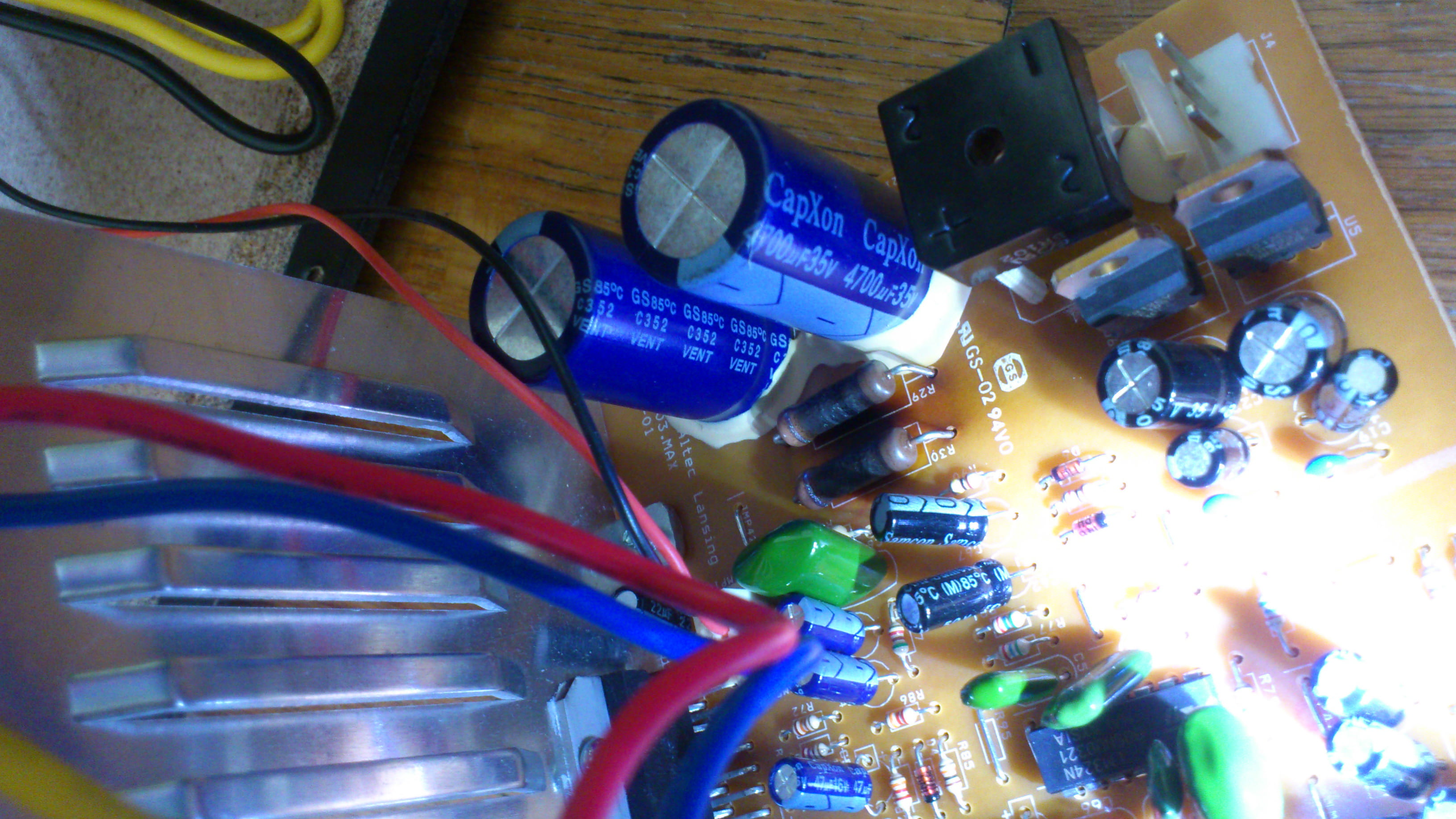
Well, I've just reopened the beast, I've tested the transformer which seems to be working (17V AC output). But I noticed black marks around two resistors right next to the capacitors. They seem to be functioning (100 Ohms each), but if they are connected to the capacitors, it would mean that the problem really comes from them. They don't necessarily have to be exploded to be defective, do they...? I'm measuring an internal resistance for the capacitors of 150 kOhms for one and 9 kOhms for the other, even though they are identical. That seems low to me. I'm willing to give it a shot to replace them if I can find some and if it doesn't cost more than a few euros... (and if they can be found in an electronics store in Dijon).
1000V/mm is in the air saturated with humidity (100% humidity), which is rarely the case in practice; we are rather around 50% on average. Well, but that's still a rough idea, there are other factors (temperature...)-
no way to enlarge!!!
the resistors are probably after the capacitors towards other circuits and so the issue would be (presumably) after the resistors (??),
the 2 large caps power the power transistors on the heatsinks
cap:
http://www.selectronic.fr/chimique-radial-c136-4700-f-25v.html
https://www.conrad.fr/p/condensateur-electrolytique-4700-f-35-v-20-x-l-25-mm-x-49-mm-1-pcs-471798
If you have electronics stores in Dijon, it’s faster than online, but I doubt it’s them, check more thoroughly -
And obviously, if a chip or microprocessor is damaged beyond the resistors, that isn't necessarily visible, am I wrong? In short, either I take the gamble by replacing the capacitors, or I give up...
But the power supply of the wired remote is dead (LED off), while the capacitors are certainly on a different circuit, specific to amplification. Isn't this proof that there is another issue? -
-
-
But I detect a resistance (round: 100 Ohms) at the terminals of the resistors, despite their state, does that mean they are working....?
Yes and no!!!
To be sure, you need to desolder it and measure it, then YES
measured in-situ you might measure something else, then NO
100 ohms = brown-black-brown-gold or silver
-