Inverter that turns off quickly
Solved
Wolgulc Posted messages 175 Registration date Status Member Last intervention -
Hello!
Having experienced power outages within a few days, which indicated "Overvoltage upstream" on my meter, I noticed that my UPS (which is a Hero Touch LCD purchased from Infosec) was beeping very quickly and did not allow me to turn off the devices connected to it effectively, as soon as I try to turn off my computer, it turns off suddenly. Is the problem with the battery or the power outage itself?
Because I have had this UPS for 4 years and this has only happened once during all this time.
8 answers
-
Hello
Contact the customer service of Infosec.
-
Hello
For the signal "upstream overvoltage," you need to contact the Enedis troubleshooting service; it's the Linky that should display this message.
(Normally, there are other display signals on the inverter for the battery status, provided that the device is still able to show them. However, the rapid beep indicating that you should contact Infosec's customer service may conceal a lack of battery diagnostics at the moment.)
-
-
The batteries of an inverter have a lifespan of 2 to 3 years max.
Check if you have inverter management software with a battery test.-
Thank you
I don't have a battery test, but there is a screen on it that indicates a power outage.
Output voltage: 230v
Input voltage: 230v
Charge level: 20/22%
Battery capacity: 100%Is the charge level a problem?
Yes, clearly, the load level of an inverter to operate under minimally acceptable conditions must be at least 85%. Your inverter does not stay powered long enough to allow the batteries to charge, or they are dead.
Hello
I don't know about the charge level; my knowledge and my level of English don't allow me to understand if it refers to "battery charge," which could recover since the device can charge its batteries even when turned off, provided it remains plugged in. Battery capacity would then be a perfect health state, with the batteries remaining at the same stage as during the last calibration according to the software. In the case of lithium batteries, that wouldn't be entirely logical after 4 years since they always wear out.
If it refers to the device's charge, meaning the power used by what is plugged into it (PC, monitor, printer...) compared to what the UPS can provide in maximum power, that's very good, so it is not overloaded.
Yes, there is an overload warning indicator that lights up when too much "power" is requested or when too many PCs are connected to it, so I have doubts as I don't use these UPS systems.
After an "electrical surge alert" with several power cuts, I doubt everything, sorry.
-
-
I checked and the battery level and the percentage used by the device connected to it, for my part, as mentioned above, it only uses 20% or at most 40%, Infosec advises not to exceed 75%.
So I'm trying to figure out how to know the state of the battery power, because their program called Infopower, their download links are broken.
-
You need to check if you are plugged into the right outlets; on most UPS devices, there are protected outlets and others that are not.
-
Hello
"After in another place"
Of course, if it didn't suffer the failure that displayed "upstream overvoltage" on the Linky, the other inverter didn't experience anything similar.
The inverter shows normal current values because it is on "bypass" as the diagram says, but this is not a workshop test done by flo88 because he is really a technician just like the Infosec customer service, at least on the surface he returned from the "quick beep" alert which required going to customer service workshop.
He may have very well protected the computer, but stayed down himself in this case.
We are in a curious case where 2 different devices, the Linky on the Enedis sector issued a completely abnormal overvoltage alert which normally requires an intervention from Enedis, and an inverter downstream issued another alert and then malfunctions, which could very well still be damaged if there really was an overvoltage, and the multiple cuts seem to confirm it. The story seems plausible for a cause at the supplier's level but these are just deductions not device checks in the workshop, and EDF no longer guarantees reliability since European international networks are interconnected.
An insurance would have the inverter assessed in this case and it goes to customer service and would also conduct an investigation with Enedis possibly regarding the incident that took place.
It costs money but it is what works in this situation and does not automatically lead to compensation from the supplier or coverage by an insurance.
-
So the problem may only come from the inverter which can be variable, because it doesn't come from this one since it is still correct.
Until now, I had no issues with this Infosec inverter, however my previous one which was an Eaton did not hold during certain power cuts (knowing that I have another one that holds everything, but has very few things plugged into it for several years), but as long as these ones ensure that the devices (especially the PC) are not damaged, that's already something.
Thank you again for your help.
-
Here I am again, I had to wait for Infosec to provide the link to download the program to check the uninterruptible power supply (UPS) and here's what it indicates to me
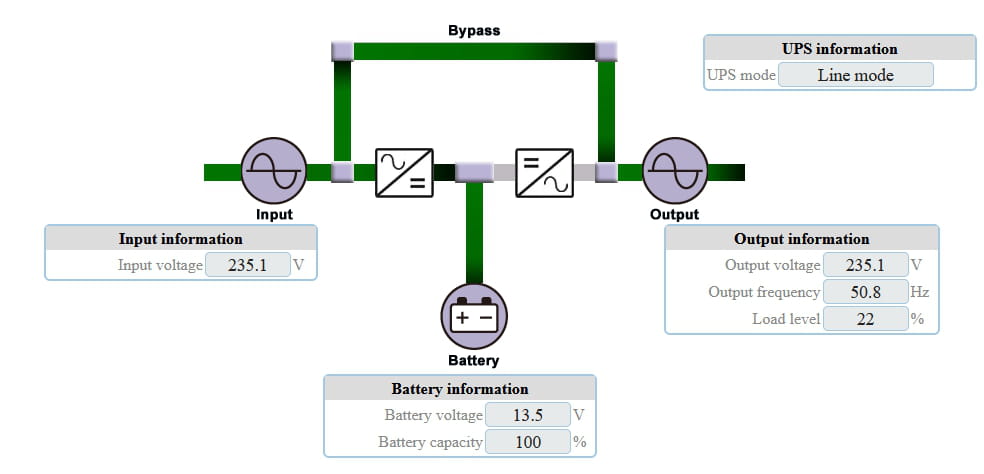
Everything seems correct except for the battery which has a low voltage, but could it be because it's not active?
-
The battery voltage is normal, it's 12v. Don't forget that a battery delivers direct current, which is then transformed into alternating current at 230 via an inverter when the power goes out.
If your inverter does not hold up during power outages, it may simply be poorly calibrated in relation to what you are asking of it.
Weird! It indicates that I'm only using 22% of what the inverter offers (Section titled "Load Level).
I think it's similar to older inverters; sometimes certain power outages would give you time, and sometimes it was abrupt and I didn't have time to do anything.
So if the battery is still good, it must just be a matter of luck as to how the inverter will handle it.
Knowing that for the calibration I had actually asked for advice on a forum here about which inverter to choose and according to my request, this one was the best.
Additionally, in another place, I have an Eaton inverter that is already several years old and it still works ^^
ok, I just saw the discussion you mentioned........Let's not kid ourselves, I didn't know infosec and it's just fine like that..., a UPS should take over in all circumstances, that's its purpose, I worked for many years in the industry and I had quite a few UPS for PCs and PLCs, all Eaton, never had a problem, except sometimes when one was defective before a power cut.....And in case of a storm too, there were surprises but never due to a failure or drop in EDF voltage.
To prevent a failing UPS from going unnoticed, we conducted tests once a month. Now self-employed, I stick with Eaton and continue to conduct regular power cut tests.
-
-
Except that here it's the inverter, not the sockets, but I contacted Infosec to report the issue with their program that is impossible to download, and they warned me that they would fix it.