Samsung QE85Q60 TV, lifespan
Solved
Gibolin_5340
Posted messages
8
Status
Member
-
Gibolin_5340 Posted messages 8 Status Member -
Gibolin_5340 Posted messages 8 Status Member -
Good evening everyone,
I would like to know the estimated lifespan of the screen of my Samsung QE85Q60 TV since there is so much conflicting information out there.
Thank you in advance,
Configuration: Windows / Chrome 101.0.4951.41
--
Bruno
I would like to know the estimated lifespan of the screen of my Samsung QE85Q60 TV since there is so much conflicting information out there.
Thank you in advance,
Configuration: Windows / Chrome 101.0.4951.41
--
Bruno
3 answers
-
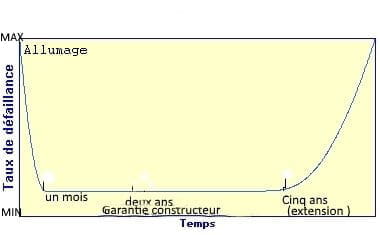
And the famous "bathtub curve" considers that the failure rate starts to increase after five years
--
I call a spade a spade *
*in French in the text-
Hello,
In any case, and since Samsung fails to publish this information in the device manual, we read here and there that the average MTBF of an LED screen is between 30,000 and 50,000 hours.
This means, I know, these are only statistics, that for the lower value it is expected to work roughly 3 and a half years 24/7 or about ten years at 6 hours a day, which leaves some time unless, of course, the other components are the weak link.
-
-
Good evening,
That's exactly why I speak of estimated lifespan; for example, the bulb in my old Philips projector lasts 30,000 hours.
-
Good evening.
There is no lifespan in reality and the end can occur at any moment.
--
Just a little note to say thank you, it’s always nice to hear…-
Good evening,
Failures are of course more or less random, but manufacturers of different equipment take into account the MTBF (Mean Time Before Failure).
I don’t know if it is mandatory or standardized, but these manufacturers use it themselves in their industrial processes: a TV brand that outsources its own panels has every interest in buying them from a supplier with a high MTBF.
However, it is just a purely statistical measure based on large samples, which does not necessarily take into account specific operating conditions (temperature, humidity...).
And statistics do not prevent, even if they are very favorable, from encountering an item that is far from the average and outside of specific conditions; this is still more likely to happen with a device using many machined parts where, in the absence of strict control, one will always be at the mercy of one part that is out of standards or poorly assembled.
-