Unknown suspicious MMS
Didi64_549 Posted messages 2847 Registration date Status Member Last intervention -
Good evening
Good evening community, I received an MMS from an unknown number with a link vwww.vosmms.com and a code written "trust"
I found this famous code strange, I wonder if it's just a coincidence or if it’s meant to make me click on the MMS as a precaution, I deleted the message because I don't want to be a victim of hacking on my phone. I am perplexed and would like to know your opinions. Thank you very much!
5 answers
-
Hello,
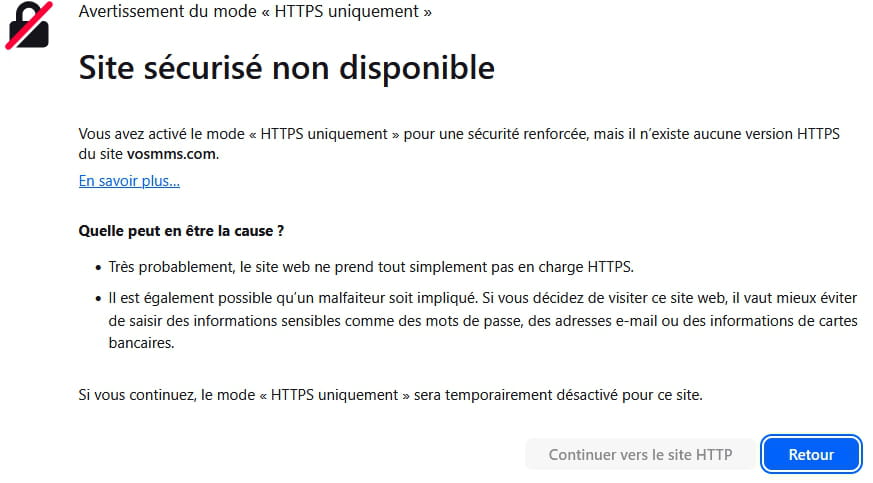
- apparently this site is not secure.
- here is the message I get with Firefox:
-
I also advise against it.
-
Hello,
The website in question does indeed have a secure https address and in my case, Firefox does not respond.
The domain is not illegitimate per se, it belongs to SFR and these links are sent when the MMS cannot be received by the recipient (lack of network coverage, exhausted plan...).
The notification is sent via SMS from a "number" that is usually 6245, which also belongs to SFR.
There is therefore no risk in following the link in question unless the domain and the phone number had been hijacked, although the general rule is to never follow a link and there is no urgency to receive an MMS that the sender will undoubtedly resend when conditions are better if it is truly important.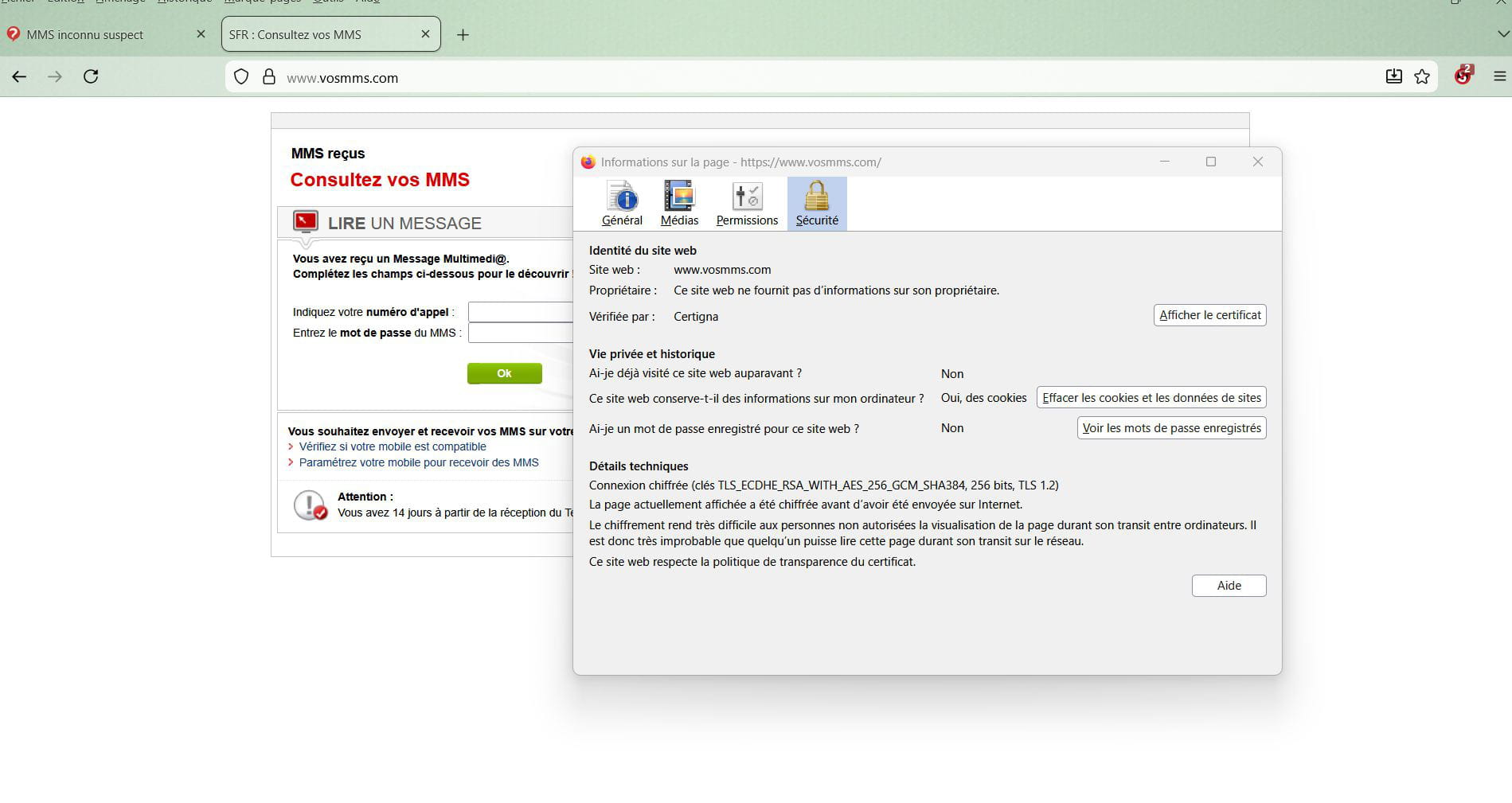
Hello,
Do not reply to a text message if you do not know the person or the website, because usually those who send you a text message do so as it is normally agreed upon between you and your acquaintances.
So think Scams when you haven't asked for anything.
Have a nice day.
-
Hello, thank you, but I never respond to SMS and MMS. Moreover, the code and the password written "trust" seemed strange and suspicious to me. Thanks again and have a good day to you too.
Hi,
I got seriously scammed on my landline by someone claiming to be from SFR, and this woman asked me to dial a number with my landline, which I did, and a counter started to run at a crazy speed.
If I hadn't hung up quickly when I realized what was happening, it would have been around 100 euros or more.
I can't remember exactly what it was about, except that it was supposed to be SFR, and when I called them, they told me that they no longer called anyone by phone, that they didn't send emails or texts to anyone either, and that everything was handled through the contract and the SFR account, so sfr.fr and checking the Client area regularly.
But SFR was aware of this scam and refunded me without hesitation.
It's just like with your bank, it all happens on the account and nowhere else.
I'm more cautious now and don't care what others say.
Have a good day.
Hello.
At one time, this procedure was often done without risk,
I have used it myself, of course after verification, and I have never experienced overcharging or hacking.
It is SFR that keeps this usage principle alive, it's just that the principle is old.
And it is actually a legitimate site despite what one might think.
You just need to go to the site (which you will type yourself), and the code is just used to unlock access to this mms.
-
-
https://www.europe1.fr/technologies/a-dangerous-vulnerability-in-android-smartphones-1371220
A vulnerability allows hacking an Android phone via MMS without the user realizing it, according to the cybersecurity company Zimperium.
A flaw in Android, Google's operating system, allows hackers to take control of a smartphone through a simple MMS, cybersecurity company Zimperium warned on Monday.
"Attackers only need your phone number, and by using it they can execute programs remotely via a specially crafted file delivered by MMS," Zimperium explains on its blog.
"Extremely dangerous." The cybersecurity company specifies that the message used in the attack can even be deleted before the smartphone owner reads it, according to findings by Joshua Drake, one of Zimperium's research team leaders. The flaw relies on a feature called "Stagefright," which automatically pre-downloads video clips attached to texts to prevent the recipient from having to wait to watch them.
Hackers can hide malicious programs in these video files, and they will be activated even if the smartphone owner does not read the message, Zimperium details. "Anyone can be targeted by this type of attack," it warns. "These vulnerabilities are extremely dangerous because they do not require any action from the victim to be exploited."
-
-
This is applicable if you click on the link directly in the received SMS.
And it concerns MMS that are much more recent than those we received during the SFR era.
This is not the case here because you can go directly to the site via a computer or tablet, and then enter the code.
I speak from experience, but your choice not to look is perfectly respectable and I won't contradict you.
I'm just sharing my experience and what I know. -
Hi there,
MMS messages can contain viruses
SMS messages are secure because they rely solely on text and cannot be used to transmit malicious content via attachments.MMS, on the other hand, exposes you to a new type of risk due to their ability to transmit different types of files.
And there’s a whole text on the subject of various scams:
Scams have been multiplying lately. Fake messages from your loved ones, convincing deepfake videos, or fake package scams... In 2025, new forms of fraud are emerging. In this article, we help you identify and protect yourself from them.
Artificial intelligence at the service of scammers
Artificial intelligence (AI) is an impressive technology that can facilitate your daily life by performing many tasks. However, it is also exploited by malicious individuals.
One of the most widespread scams is the deepfake, also known as hyper-manipulation in French. This is a technique that uses AI to modify images or videos. Specifically, it can mimic a person's face and voice to make them say or do things they have never actually said or done. This method is often used to spread false information.
Deepfakes are notably used on dating sites, where scammers impersonate celebrities or well-known figures to deceive their victims, who are generally seniors.
So be vigilant when interacting online, whether on social media or other platforms: behind a screen, not everyone has good intentions.
Beware of fake calls from your bank!
A new scam is trending among scammers: fake calls from your bank advisor. These fraudsters call you claiming they need to block or cancel a suspicious operation on your account, like a transfer or a credit card payment. This is a scam!
In reality, these scammers are trying to get you to approve a fraudulent operation, not to block it. The difficulty is that they have technology that enables them to call you while displaying your bank's actual phone number. Sometimes, during the conversation, they mention personal information, and you end up believing they really have your file in front of them.
Remember that a real bank advisor will never ask you to carry out an important operation over the phone. Never share your personal or banking information and do not approve any operation requested this way. Hang up immediately and contact your bank right away using the official number found on your statements or bank card.
Scam: beware of fraud when shopping online
With the rise of online shopping, internet fraud is multiplying, especially with fake sales sites. These scams aim to steal your banking information by encouraging you to make payments on fraudulent platforms.
To avoid these traps, take the time to verify the site you are on. If its appearance seems strange to you or if the address (URL) is unfamiliar, it is better not to take any risks. Leave the page immediately and do not make any purchases to protect your personal and banking data.
Sometimes, the page eerily resembles your bank's interface or an official site. Here are some strange things that should raise your suspicions:
- The URL does not include an "s" after http (the "s" means the browsing is secure)
- The page contains spelling mistakes
- The URL does not match the official site URL (sometimes the differences are very subtle: one letter more or less...)
Beware of fake messages from your loved ones!
A new scam increasingly targets seniors: fake personal messages. Cybercriminals impersonate a family member using sophisticated techniques, such as artificial intelligence, to create fake profiles and very convincing photo montages.
Be especially cautious of unexpected messages. For example: "Hi mom, it's your daughter, I've changed my number, contact me on WhatsApp by clicking here."
Never respond to this type of message! These scammers often seek to extract money from you or obtain your personal information. If in doubt, contact your relative directly using their old number or seek advice from a family member before responding to a suspicious message.
The fake package scam
This scam relies on sending a fake message claiming that a package could not be delivered. The goal of the scammers is to entice you to click on a link. To extract your banking information so that they can steal it.
Here is an example of a fake message: "Your package could not be delivered. Please click this link to reschedule the delivery."
To avoid this trap, be wary of messages related to packages you are not expecting. Always verify the sender before acting, and never click on a link without being sure of its reliability. In case of doubt, contact the relevant delivery service directly.
How to protect yourself from these scams in 2025?
Here are some of our tips to avoid online scams:
Use secure passwords
Choose complex and different passwords for each site and write them down in a notebook so you don't forget them. Having a unique password for each website prevents hackers from accessing all your accounts in case your information is stolen.
Be cautious with suspicious messages
Never click on a link received via SMS or email. If you have the slightest doubt about its origin, seek advice from your loved ones.
Keep your devices updated
Regularly update your digital devices: phones, tablets, or computers to protect yourself from new threats. A device that is not updated is more likely to be easily attacked by cybercriminals.
In case of fraud, you are not alone!
If you are a victim of an online scam, you can get free help on the official site 17cyber.gouv.fr that will guide you through the procedure to follow.
-
Absolutely. There are many similar scams, such as those involving fake bankers or delivery people. Individuals without phones ask to be added on WhatsApp, and recently, a new scam involves soliciting votes for children through fake links sent on WhatsApp. I am well-informed about these online scams and their methods for manipulating people.
To keep it simple:
The link in question in the email is this one and poses no risk to the computer:
https://www.vosmms.com/
It is an old system, as old as the operator in question, that allows you to read MMS on a web platform, because at one time, not all phones could read MMS.
To do this, you had to enter the address I just provided on a web page, input the destination number (yours), and the code given in the MMS.
This allowed you to view the content of the MMS via a web page.
Under no circumstances am I encouraging anyone to click on the link provided in the MMS.
DO NOT CONFUSE WITH
messages like: "your package does not fit in the mailbox, click here to reschedule a delivery", or: "your credit card has expired, please update your information by clicking here", and there are many others that are indeed traps.
Thank you for that nice copy/paste in response 14, which is only 1% relevant to the initial request, and which, in its content, only partially addresses the principle of hacking or scams via SMS/MMS.
The principle mentioned in the initial request and the SFR site in question are old, that's all.
EDIT: the link I posted in this post (identical to the one proposed in your message) is safe; otherwise, CCM would have blacklisted it...
-