Replace telephone socket (PTT 298) with RJ45
Samikaze
-
brupala Posted messages 111189 Registration date Status Member Last intervention -
brupala Posted messages 111189 Registration date Status Member Last intervention -
Greetings,
Let me explain the context: I am with Free, Freebox Revolution + fiber optic, the box is in the living room and there is a telephone socket nearby (not used of course). In my bedroom, there is a perfectly identical telephone socket (color and number of cables, etc.).
My question is: is it possible to replace the two telephone sockets to convert them into RJ45 and thus connect my PC via Ethernet to the box?
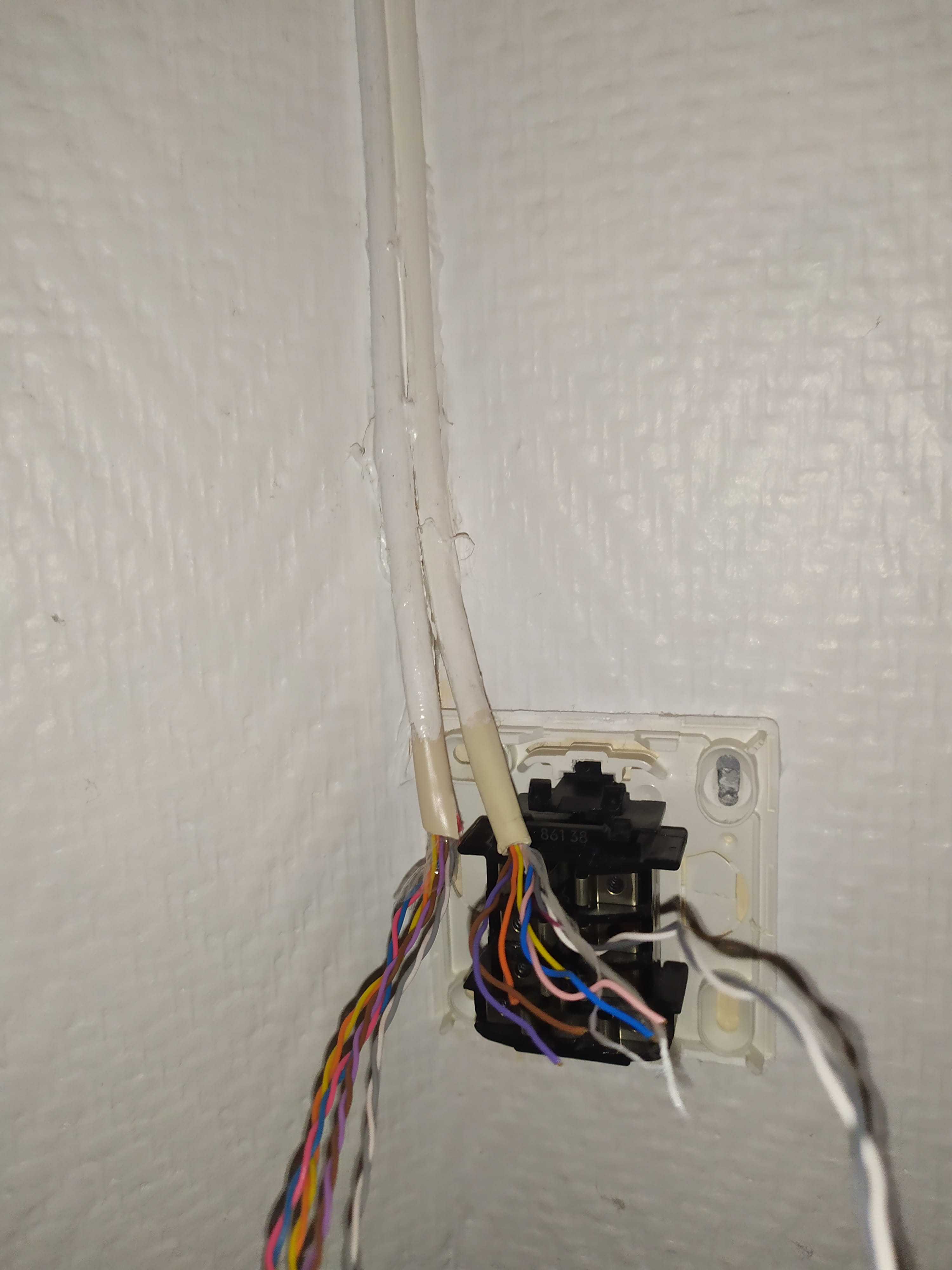
I am attaching a photo of the socket, as well as the 4 pairs of cables behind it so that you can see the colors.
https://www.noelshack.com/2021-04-6-1612027824-img-20210130-182141.jpg
Thank you in advance for your expertise.
Let me explain the context: I am with Free, Freebox Revolution + fiber optic, the box is in the living room and there is a telephone socket nearby (not used of course). In my bedroom, there is a perfectly identical telephone socket (color and number of cables, etc.).
My question is: is it possible to replace the two telephone sockets to convert them into RJ45 and thus connect my PC via Ethernet to the box?
I am attaching a photo of the socket, as well as the 4 pairs of cables behind it so that you can see the colors.
https://www.noelshack.com/2021-04-6-1612027824-img-20210130-182141.jpg
Thank you in advance for your expertise.
9 answers
-
Hello,
The PTT298 cable can be used for Ethernet. For RJ45 wall sockets, the wiring principle is color/number:
And in the central box, at the end of the 2 cables, two female RJ45 sockets should be installed, wired in the same way, plus an Ethernet cord between these two female sockets.
-
Hello,
There is a good chance that the cable coming into the living room is not the same as the one going into the bedroom.
Normally, these cables are connected to the DTI, which should be located nearby or in the electrical cabinet...
So you'll need to disconnect them on the DTI side and connect them to 2 female RJ45 sockets to clip onto a DIN rail, then connect these sockets to each other with an Ethernet cable.
--
It’s very difficult to catch a black cat in a dark room.
Especially when it’s not there… -
Ok, I'm quite lost. By "central unit" I imagine you're talking about that famous DTI?
Well, I'll try to find it even though I have no idea what it might look like.-
-
-
Normally, the telephone line arrives at a central point on the DTI. From there, there is a connection to each wall socket; we could say it's a star or parallel connection.
If your second telephone socket is connected after the first, it could be likened to a series connection.
In the first case, you need to find the starting point (and possibly the DTI); in the second, you just need to install a wall socket on the cable that is the departure for the second one, but which one is it? -
-
Before fiber, you were likely on ADSL with the box connected to the T socket?
So the telephone line came into the T socket and went out to the second room.
From the T socket, we could determine the incoming cable (on 1/3 on the T to the left) and the outgoing cable (on the right of the T socket). Now, with the two stripped cables, we can't tell which one goes to your second T socket.
-
-
OK... for Auvergne...
There is, as Jee pee says, necessarily a box where the telephone cable arrives.
(Note that the fiber must have come through the same route and must have passed by this box before being installed in the living room.)
If you are in a building, this may be located in a landing cupboard.-
-
-
-
The fiber came directly from outside to the first floor in the living room. OK.
The telephone cable, outside, it didn't arrive at the same spot on the facade?
There is a good chance that the fiber followed the same path as the telephone line.
Is there not a box in the living room located near where the fiber comes in?
Where was the box before? In the bedroom, in the living room? -
The box has always been in the living room.
Logically, the fiber must have followed the same path. However, it seems to me that they added a cable and drilled a hole in the facade, so that may not be the case.
I took a few photos to show how it is arranged.
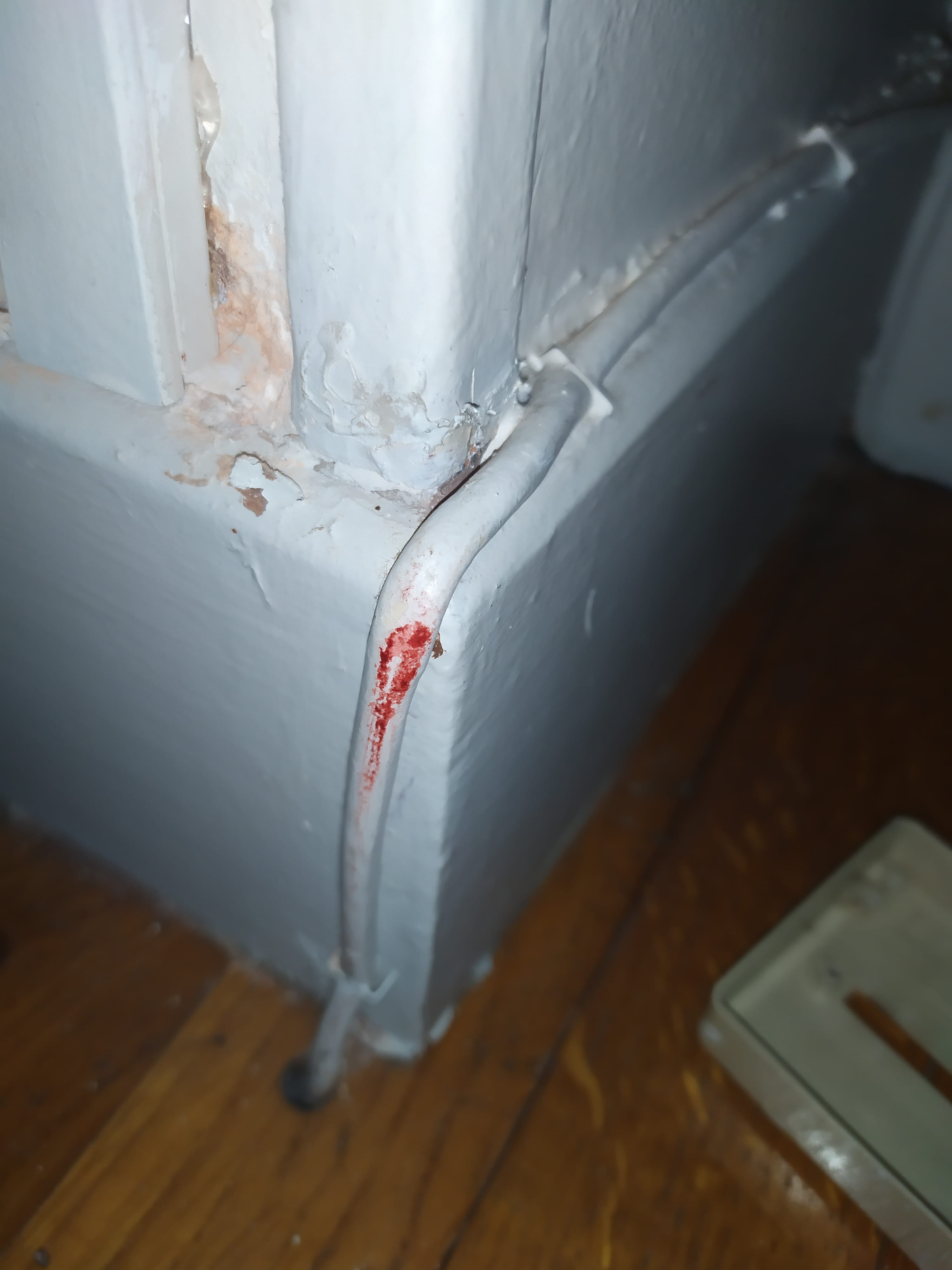
Here you can see where the cable enters the living room (from the facade):
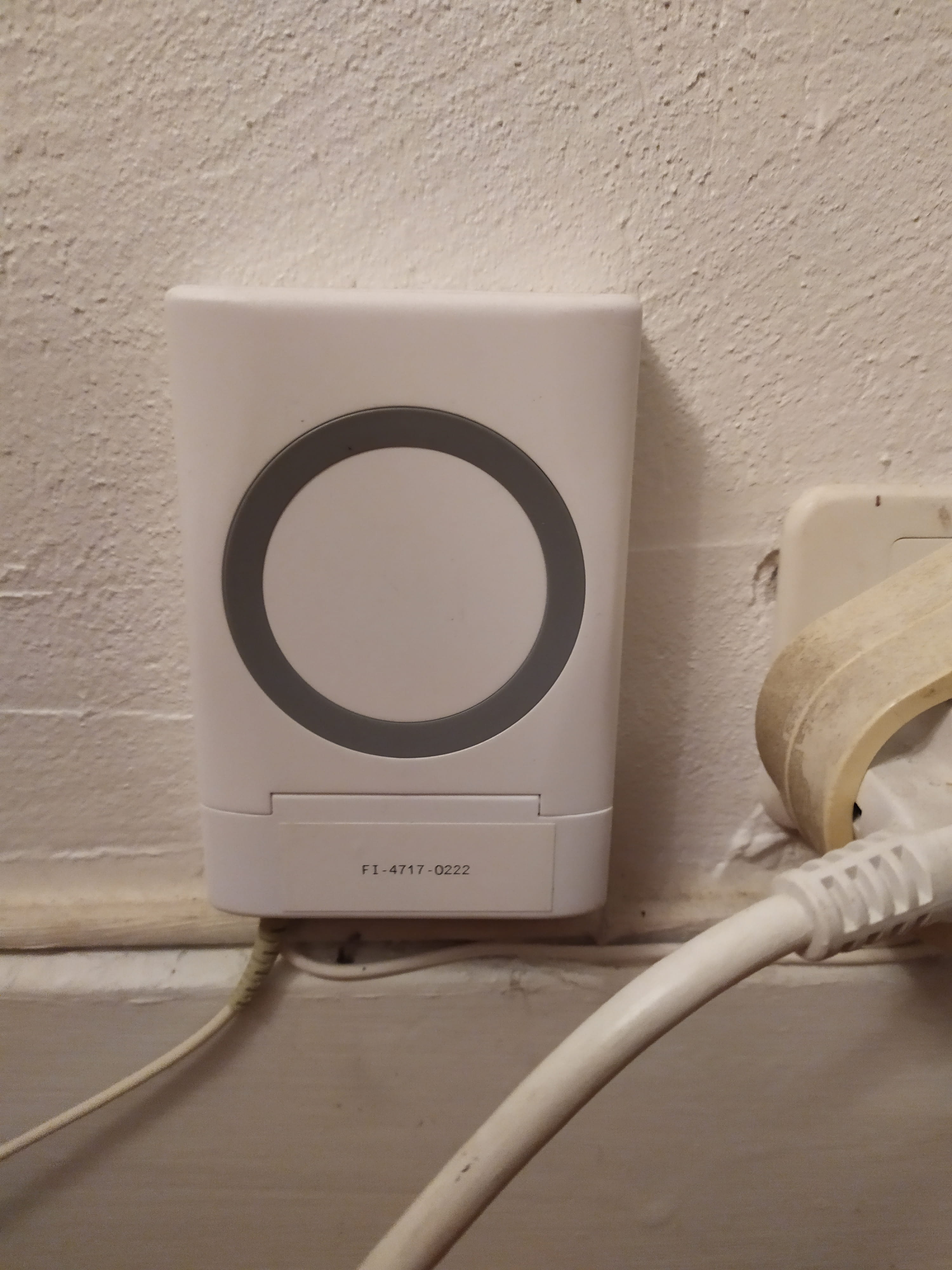
Then this cable meets this box (provided with the fiber installation):
Coming back to the telephone cable, the telephone socket in my bedroom seems interesting:
I know that the cable on the left comes out of my bedroom to reach the facade, then runs along it until it reaches the electric pole where the starting point of the fiber cable is also located. The cable on the right enters the wall, but I couldn't say where it goes.
-
-
The box has always been in the living room.
The telephone cable used to arrive at the same spot on the facade, I think it makes sense. The fiber must follow the same path.
I took a few photos to show how it's arranged.
In this picture, you can see the hole through which the cable enters the living room from the facade:

Then, the first box encountered by the cable from the first photo is this one (which came with the fiber installation):

-
The gray and white wires plugged into the socket came from the cable on the right, that is to say the one going into the wall, not the one coming out.
Here is the telephone socket in the living room (previously used for ADSL):
The socket in the bedroom didn't seem to be used
So there is only one cable with gray and white connected.
There are a total of 6 telephone sockets in the house: one in the living room, one in the hallway adjacent to the living room socket, one in my bedroom, one in another bedroom, one (adjacent to the one in the hallway and the living room) at the back of a room next to the living room and just above my bedroom, and still in that same room, a socket on the same wall as my bedroom socket. This last one seemed particularly interesting to me because I think it is connected to my bedroom socket and to the line itself:


Since it’s becoming chaotic, I made a little diagram hoping to facilitate understanding (be careful it may be erroneous
but I think the configuration is somewhat similar):

-
In your drawing, we only see 4 sockets, where are the other two?
If I understand correctly, the line would arrive in the attic of the house.
Can you check if the outdoor cable is black or ivory like the PTT298s you show us in your photos?
Logically, if the outdoor cable enters the attic, it should reach a 12-pin terminal located in the attic from which the PTT298s connect to the sockets.
These terminals look like this or for the more recent ones with CAD contacts.
But basically, the idea is to identify both ends of each cable; I assume you are not equipped to trace and identify them as I have asked you earlier (<32>). In fact, your telephone connection belongs to the past.
If you need to use 2 cables to connect your two sockets (parallel wiring instead of star wiring), it is possible to add a connection module to link the two. -
I'm starting to sweat because I don't even know what I should be looking for and what I should understand.
The other two sockets were complicated to draw and not necessarily useful. Basically, there's one adjacent to the living room and the room (they form a sort of trio) and another in a room behind (on the garden side and not the facade side).
By attic, what exactly do you mean? The room that I haven't named?
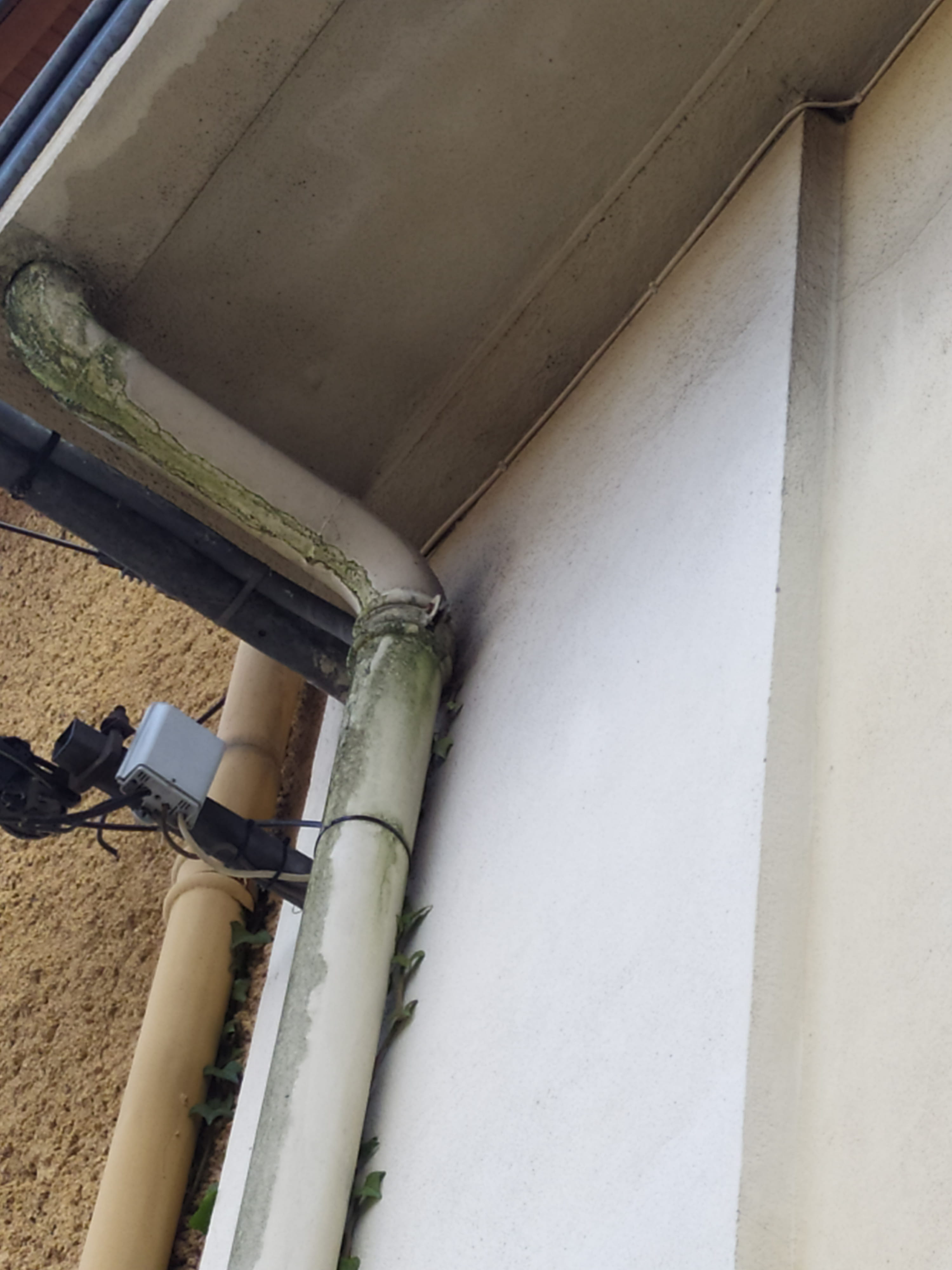
So indeed, there are two cables running along the facade:

The white cable coming out of my bedroom corresponds to the left cable (which wasn't connected to any wire when I disassembled the socket) in this photo of my T socket that I showed previously, I'm 100% sure:
You can also see the black cable which is the PTT 298 if I understood correctly, which joins it and follows exactly the same path as I observed:

I've checked it well and even if it's not very clear in the photos, the black cable follows the same path.
Arrival:
So it's just a matter of figuring out where this black cable comes from, I imagine?
Given where it comes out, I think it should correspond to the famous right cable (from my T socket) which goes into the wall like this (and which was connected to the socket when I disassembled it):
But in this case, how does this socket communicate with the others? Does the white cable on the facade correspond to an old unused line now? -
OK,
the attic, if you prefer, is the space between the roof and the ceiling of the highest floor.
But clearly your arrival line does not go through there but outside, I had doubts based on your drawing, but not in the photos.
I think the arrival is indeed in this socket, the two thicker wires at the top left.
The PTT298 cable is the ivory cable that we see in all your sockets, not the black cable, the black one is more like a 98 or a 92 or this kind
Indeed, it should come in above your bedroom.
But all of this still doesn’t tell us if there is a cable between your bedroom and the living room, directly or in several sections.
The white cable coming down from the PC (concentration point), the gray box, you say it reaches your bedroom but was no longer connected, so clearly, we can eliminate that one, it does not go to the living room socket, so we need to focus on the other one.
Does it go above, from where we could send it back to the living room through the old ADSL arrival in the living room? -
Ok so we're forgetting the left cable from the T socket in my room (ground floor) that goes out to the front and was not connected:
https://img-19.ccm2.net/7yE7qUGrTl6eYxo9UztS_ngrFdM=/440x/d1f027394a27419bbdbc253b2689d679/ccm-ugc/1612046070776.jpg
So the right cable (white and gray wires that were connected) likely goes up to the socket where three cables converge.
Let's go back upstairs (I remind you that my room is below the room at the bottom left of the diagram):
We can see that the T socket in the living room is connected to this one:
https://img-19.ccm2.net/kknU124t5AiUCzoa9Vs1y8LbhOc=/c0e557484ce845f882e0ab9a119b77bf/ccm-ugc/1612051604591.jpg
So it's left to confirm that the T socket in the room at the bottom left communicates with the one in my room right below, doesn't it (which seems probable to me)?
"You say it comes into your room but was no longer connected, clearly, we eliminate that one, so it doesn't go to the living room socket, we need to focus on the other one." By the other one, do you mean the black cable that joins the white cable on the front and then follows its path? If it's a cable allowing ADSL to pass through, why would it be of interest? -
I didn't say to focus on the black cable. On the contrary, if it only brought the ADSL line, we leave it alone too; it's just to know more about the overall routing that you're having trouble analyzing.
Afterwards,
your new diagram doesn't match the first one where you had a garage and your room is indeed on the right, not on the left. Right?
-
-
Well... 6 outlets in the house...
I actually think there are some series wiring and other parallel ones in this house.
One outlet exists "above my bedroom"; it's probably where the PTT cable comes in (it's black and not ivory)..
Since the box is located on the same floor and next to the room where we want internet, I think the simplest solution is to install an Ethernet cable between the living room and the bedroom by drilling through the partition.
This cable might already exist and can probably be reused.
We need to test if this cable actually exists or not.
Otherwise, we need to run a new one.
A RJ45 female outlet "surface-mounted" on the living room side and one on the bedroom side.
Finally, if multiple devices need to connect in the bedroom, we will need to plan for a switch..
--
Very difficult to catch a black cat in a dark room.
Especially when it isn't there... -
Hi, it's better like this https://www.noelshack.com/2021-04-6-1612027824-img-20210130-182141.jpg
--
Man is not born for rest: Voltaire -
Samikase with an English IP.... the DTI does not exist over there..
You need to find the BT (British Telecom) arrival socket
See https://fr.qaz.wiki/wiki/British_telephone_socket
It's very difficult to catch a black cat in a dark room.
Especially when it isn't there...