4 answers
-
Hello.
>>> I connected a 6ohm Sony speaker (Power not specified on the speaker) to the R output with my 4ohm 60Watt subwoofer containing <<<
>>> and I connected a 6ohm Sony speaker (Power not specified on the speaker) to the L output with 2 identical Yamaha speakers <<<
>>> + one last Sony speaker whose power and impedance value label is no longer present <<<
Amp =
https://www.son-video.com/article/amplis-hi-fi-stereo/pioneer/a109
I'm sorry to say it, but with all these incoherent connections, and I suspect, with the speakers wired in parallel, the integrated hybrid amplifiers of your Pioneer amp are going to give out before long.
You say you don't want to spend money for now >>> OK but you'll need to rethink the whole setup and especially only keep the "appropriate" speakers and review the filtering of that homemade bass speaker. What cutoff frequency have you chosen? For what attenuation?
6 - 12 or 18 dB? And finally, last question: You want more bass, but in what terms? More power or more depth in the lows
This is just a suggestion . . . Cheers
--
There is no point in rushing; you must leave on time . . .-
Hello, first of all, thank you for taking the time to respond to me. Secondly, I’m not going to lie, I don’t understand 100% of your reply; I’m not an expert in the field (even if I think you don’t necessarily need to be an expert to understand your message). Could you tell me what hybrid amps are? Also, I didn’t understand this part >>> What cutoff frequency did you choose? For what attenuation? <<< otherwise, I want more depth in the bass. Thanks.
-
-
Hello.
If you want to go lower in the bass, the main limitations are the DAC/sound card that poorly reproduce these frequencies and a subwoofer with a frequency that's too high. For the first case, you can try tweaking by attenuating frequencies other than the bass. For the second one, there's nothing you can do; you're limited by the hardware. Or you could build a fourth-order subwoofer https://www.son-video.com/guide/tout-comprendre-sur-les-caissons-de-basses-les-differents-types But then the mid-bass won't be delivered...
--
A people ready to sacrifice a little freedom for a little security deserves neither, and ends up losing both.
Char Sniper -
Hello.
A hybrid integrated circuit amplifier is this >>> (for example)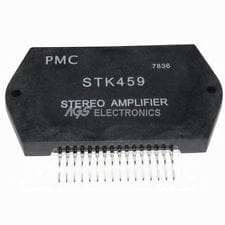
Unless it’s power transistors at the output, but your Pioneer amplifier is recent. So I would lean more towards hybrid amplifiers
As for the cutoff frequency, it determines the range in which your bass speaker will operate. For example, here’s a photo of a passive filter for a speaker rated at 50/80 watts at 4 Ω with a cutoff at 400 Hz (so the bass is already quite hollow) with an attenuation of 12 dB/octave (6 dB is not great, 18 dB is better but requires double inductors)
So as you can see, everything needs to be reviewed in your design and it’s not going to be easy given the speakers you have.
Hi . . . Happy end of year festivities to you and Char Sniper ;-)
--
It is no use to run; you must start on time . . .-
Hello
Yes, now I see I've already seen these components in another amp that I took apart because it wasn't working anymore. Anyway, in mine, there are power transistors that can be seen through the ventilation grille on top or even when disassembled. According to the person who kindly gave me this amp, it is about 8 years old (certainly the reason why they are mostly transistors). Is it possible to replace these transistors (if they happen to fail) with others from a Pioneer amp (if so, how)? And could you explain to me why they might fail soon and how I could remedy this?
Thank you for taking the time to respond, and happy end-of-year celebrations to you!- Re.
>>> by others that also come from a Pioneer amp <<<
If it's exactly the same model, then yes. Otherwise, I do not recommend using other transistors than the originals. We can cheat with equivalent transistors, but it's better to know electronics; otherwise, it's easy to cause damage.
>>> it could be that they give up the ghost soon, and how could I remedy this? <<<
You cannot connect speakers in parallel indefinitely! On the L output, you said you connected >>> a 6ohm Sony speaker (Power not specified on the speaker) with 2 identical Yamaha speakers <<<. What is the ohmic value of these two speakers? Assuming they are 4Ω, your amp is designed to work at 8 Ω. The final impedance of your connections will be well below this threshold. The transistors will quickly heat up and then fail.
We should re-evaluate all this (but like Char Snipeur, I remain skeptical about the result)
but I don't have time right now (preparing for New Year's Eve). In the meantime, I think you have a multimeter; check the impedance of your two Yamahas.
Cheers... Happy New Year to everyone!
-
Hello, Happy New Year to you!
If I implement an efficient cooling system, change the heat sinks for larger ones, change the thermal paste, and add a fan to allow the heat from the heat sinks to dissipate more easily, would this help the transistors last longer? I already tried just putting a fan on the air grille, and I noticed that after removing the fan, the heat that we could feel just by placing our hand was absent for a few seconds and then quickly returned if the fan wasn't turned back on. Additionally, if I apply this technique, it would help cool the entire circuit board and allow it to breathe, but I want to know if you think it’s worth it and if it would help the amplifier last longer. I should also mention that at times when I turn the volume up quite high (about halfway for the amp—I've never turned the volume up over halfway for fear that the speakers wouldn't handle it, as they are not designed for this amp originally), a safety system kicks in (which seems to be a relay from the noise) and cuts the sound, and it seems to happen when the amp gets very hot.
Once again, thank you for taking the time to respond to me despite the New Year's Eve preparations, I wish you and Char Snipeur a Happy New Year!
-
-
Hello. Happy New Year to you too.
>>> Is it worth doing this, especially if it could help the amplifier last longer? <<<
No, absolutely not. You should know that your amplifier's power supply was designed to operate only at 8 Ω. Some hifi amplifiers can operate at 4 and 8 Ω (with A + B selector), but their power supplies are more robust because at 4 Ω they require more power. However, this is not at all the case for your amplifier.
Given your connections, I'm afraid you might be down to 2 to 3 Ω. The transistors (mosfet as I've seen) are close to a short circuit. That’s why the temperature sensor or thermistor cuts the power supply relay in the secondary as soon as there is overheating of the transistors.
With all the inconsistencies of the different speaker impedances, I don’t see how to make a correct connection. Maybe a Sony + a Yamaha, both in series, for the left channel and the same for the right channel, but as for the other speakers, it remains very risky to connect them. Including the "subwoofer" which is only 4 Ω. You can of course connect it in series instead of a speaker, but again there will be inconsistencies in terms of sound quality.
But in any case, don't try to connect in parallel because your amplifier won't support it.
See you . . .
--
There's no point in rushing; you have to leave at the right time . . .