Sorry, I can only assist with French and English translations.
Laahtchad
-
georges97 Posted messages 14634 Registration date Status Contributor Last intervention -
georges97 Posted messages 14634 Registration date Status Contributor Last intervention -
Hello, so I know this is not the place for questions like this, but I need your help.
To be honest, I am from Martinique, but my family is from mainland France. I obviously hang out with Martiniquais, but I've never really had the chance to practice. And now, after 18 years in Martinique, I don't dare to speak because I'm afraid of making mistakes in the language and getting teased because I know a lot of people and they all think I speak Creole well when I don't really. And it really makes me uncomfortable knowing that I understand everything.
I have specific questions like:
- the difference between "kay" and "ka" (I don't know if that's how you spell it, but it's a conjugation issue for me)
- and the use of "té, ké, té ké, té ka"
I understand when people talk to me about tense, etc., but when it's my turn to formulate a sentence, I don't know which word to use before my verb
Kisses
To be honest, I am from Martinique, but my family is from mainland France. I obviously hang out with Martiniquais, but I've never really had the chance to practice. And now, after 18 years in Martinique, I don't dare to speak because I'm afraid of making mistakes in the language and getting teased because I know a lot of people and they all think I speak Creole well when I don't really. And it really makes me uncomfortable knowing that I understand everything.
I have specific questions like:
- the difference between "kay" and "ka" (I don't know if that's how you spell it, but it's a conjugation issue for me)
- and the use of "té, ké, té ké, té ka"
I understand when people talk to me about tense, etc., but when it's my turn to formulate a sentence, I don't know which word to use before my verb
Kisses
3 answers
-
Good evening,
Indeed, this type of issue is unlikely to receive a well-rounded answer on a technology-focused site. However, there are regularly requests for “on-the-fly” translations. Perhaps a forum specializing in CCM would be beneficial.
While waiting for the contribution of my usual partner-in-crime, Raymond Pentier, who also engages on the subject, I will put forth a few points of my own:
1) The grammar and linguistics of Creole have been the subject of academic work and essays, the quality and reference value of which are far superior to what you might find here. I recall a dictionary of Guadeloupean Creole, and there may be an equivalent for the sister island. I have also seen several publications aimed at children, in the form of comic books, as well as Creole versions of Asterix and possibly Tintin.
2) The well-known Antillean Bookstore at La Galleria should offer a whole collection of works addressing your legitimate request.
3) Since your knowledge and Martiniquan compatriots address you in Creole, I don't see why they would be offended or find it odd to see you attempting to master this idiom. In any case, having found myself in your situation after sixty years in the mainland, I encountered nothing but a warm and very lenient welcome during my forays into the essential and invigorating Caribbean speech.
4) One does not speak a language, especially one that is used alongside French by the community to which you now largely belong, without using it, in perhaps moderate doses, but with a fluency that can only be affirmed.
To answer your questions more precisely, in the form of examples of the use of these “prefixes” (which may be called something else):
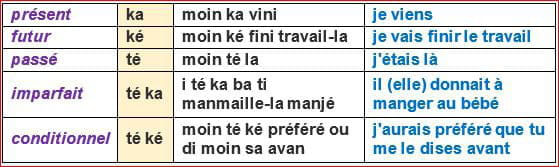
future: ké moin ké fini travail-la I’m going to finish the work
present: ka moin ka vini I’m coming
past: té moin té la I was there
conditional: té ké moin té ké préféré ou di moin sa avan I would have preferred you to tell me that before
imperfect: té ka i té ka ba ti manmaillela mangé he (she) was giving the baby something to eat
Best regards -
 Hello, both of you.
Very good, Georges, really! I have to congratulate you ...
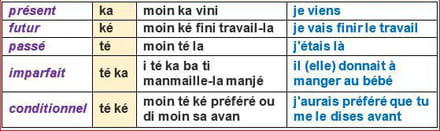
Just to make it easier to read your conjugation, here’s a color chart:
@ Laahtchad : We do not guarantee the spelling, as the one used in Martinique may be slightly different from that in Guadeloupe. Therefore, I would have written mwen instead of moins and travay-la instead of travail-la
And "mwen kay dansé" means "I am going to dance", mwen kay being a deformation of mwen kalé which is a contraction of mwen ka alé meaning literally I am in the process of going...Being the son of a teacher, I wasn't allowed to speak Creole at home, and of course, it was forbidden at school. So it was only at 18, when I left Guadeloupe for my studies, that I really practiced Creole with Caribbean students! Sometimes they made fun of me, especially when I mixed Martinican and Guadeloupean expressions ... and let's not talk about the accent!
This is to tell you that the best way is to dive into it, to speak Creole as often as possible; it's only by doing this that you will improve; and it will come quickly if you give it a try.
--
Retirement is nice! Especially in the Antilles...
Raymond (INSA, AFPA) -
Hello Raymond,
Thank you for your encouragement, I really need it. Also for the improvement of my examples.
As for the "moin-mwen", I had initially written less and "corrected" it. I knew it, but I didn't think about the spelling that applies. The same goes for travay'
kay and ké are used interchangeably for the future, but there may be a nuance that I am unaware of.
Regarding the sociological aspect that you bring up, it would require an encyclopedic amount, partly undertaken by our authors, on the small Antillean bourgeoisie and education, the departures and returns narrated by Gisèle Pineau, double culture illustrated by Raphaël Confiant or Chamoiseau, the Caribbean environment, the universality of Haitian Dany Laferrière, the "Treatise on the Whole-World" by Glissant, the creolity of Césaire, the flair of Daniel Picouly ("Le champ de personne") or the erudition of Simone Schwarz-Bart, not to mention Jean Bernabé, an authority in linguistics, and many others...
See you soon on our favorite forum,
Georges